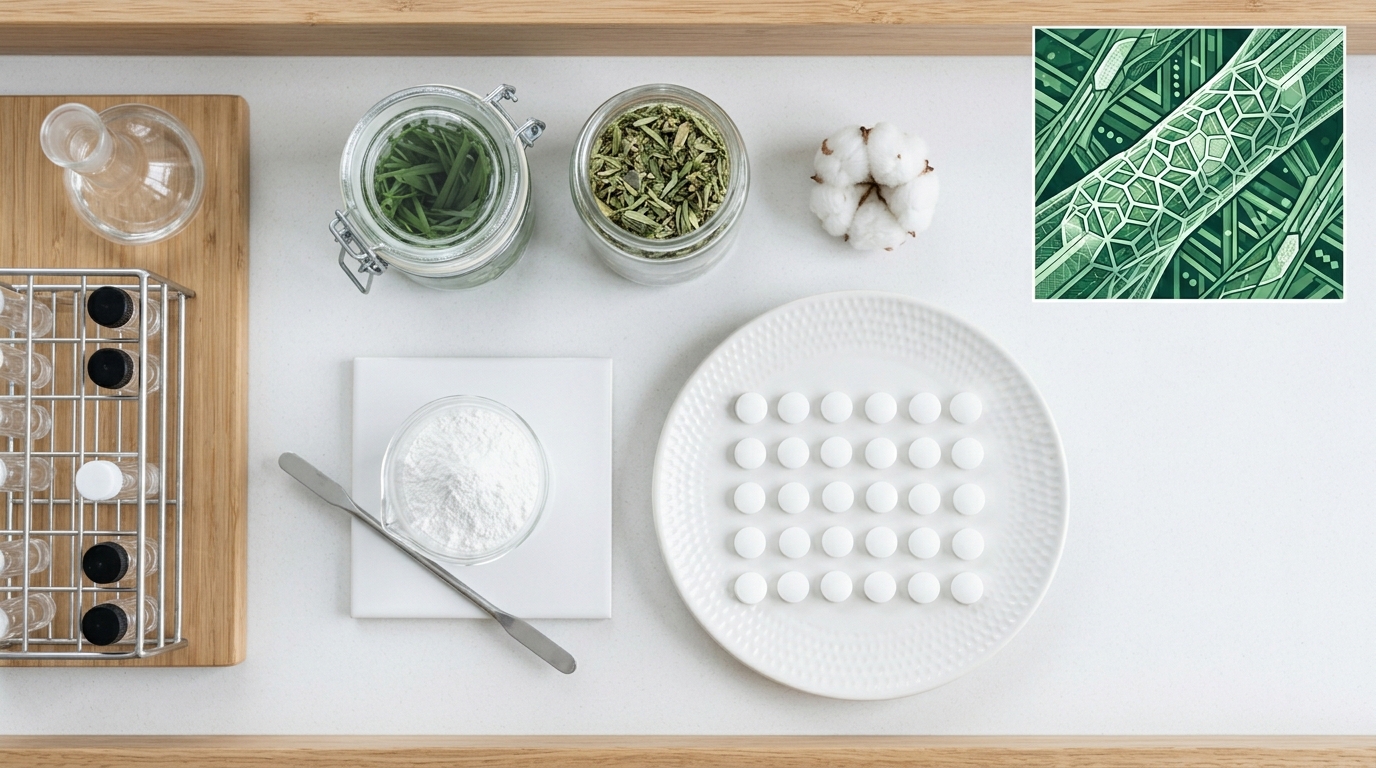
What is Microcrystalline Cellulose (MCC)?
Microcrystalline cellulose (MCC) is one of the most versatile and commonly used pharmaceutical excipients in the world. Understanding MCC is critical for anyone who is a formulation chemist, a procurement specialist, or simply inquisitive about what goes into your tablets and capsules. This thorough guide covers everything from the MCC complete form and CAS number to its manufacturing process, grades, uses, benefits, molecular weight, melting point, and how India-based producers like Maple Biotech offer premium-quality AMBICEL™ MCC globally
MCC Full Form & Other Names
Microcrystalline cellulose is the full form of MCC.It is also widely known by the following names and designations:
• Microcrystalline Cellulose other name: Cellulose, microcrystalline; Crystalline Cellulose; Avicel® (brand name by FMC BioPolymer); AMBICEL™ (brand name by Maple Biotech Pvt. Ltd.)
• E number: E460(i) approved within the European Union as a thickener, stabilizer, or emulsifier
• Pharmacopoeial name: Cellulosum Microcristallinum (Latin)
• Common abbreviations: MCC, µCCWhen you see MCC on an ingredient label or in a drug formulation document, it refers to this refined, partially depolymerized form of cellulose derived from plant sources.
Microcrystalline Cellulose CAS No. & Key Identifiers
Microcrystalline Cellulose CAS No : 9004-34-6
Molecular Formula : (C6H10O5)n
Microcrystalline Cellulose Molecular Weight: ~36,000 Da (degree of polymerization < 400)
Microcrystalline Cellulose Melting Point: Chars at ~260°C (does not melt; decomposes)
Appearance: White to off-white, odourless, tasteless powder
E Number (EU Food Code): E460(i)
Pharmacopoeias: USP, BP, EP, IP, JP
Microcrystalline cellulose is the full form of MCC. The exact melting point of microcrystalline cellulose (MCC) is not exhibited. It starts to burn and break down at about 260°C since it is a semi-crystalline carbohydrate. Thermogravimetric Analysis (TGA) and Differential Scanning Calorimetry (DSC), two crucial tests in the quality of pharmaceutical raw materials, verify this thermal stability.The molecular weight of microcrystalline cellulose varies depending on the grade and degree of polymerisation (DP < 400), however it usually averages about 36,000 Daltons. According to pharmacopoeial standards, MCC particles smaller than 5 µm cannot make up more than 10% of the total particle distribution.
What is Microcrystalline Cellulose Made Of ? Chemistry & Structure
MCC is made from an α-cellulose precursor and is pure partly depolymerised cellulose. It is a naturally occurring polymer made up of glucose units joined by 1-4 beta glycosidic links. Within plant cell walls, these linear cellulose chains are packed together to form spiral microfibrils.Each microfibril has a crystalline structure that is resistant to most chemicals and insoluble in water due to a high degree of three-dimensional internal bonding. The existence of both crystalline (ordered) and amorphous (disordered) areas is the primary structural characteristic. Highly crystalline MCC particles with superior mechanical and flow properties are left behind after the amorphous areas are carefully removed during the manufacturing process.
Microcrystalline Cellulose Manufacturing Process
Assessing the quality of a product requires an understanding of the manufacturing process for microcrystalline cellulose. There are various ways to synthesise MCC:
Acid Hydrolysis (Most Common Industrial Process)
This is the dominant commercial method used by leading microcrystalline cellulose manufacturers in India and globally:
Step 1 - Raw Material Selection: High-quality α-cellulose pulp (typically from wood pulp or cotton linters) is selected.
Step 2 - Acid Hydrolysis: The cellulose is treated with dilute mineral acids (HCl, H2SO4, or HBr). The acid selectively hydrolyzes the amorphous regions of the cellulose chains while leaving the crystalline regions intact.
Step 3 - Neutralization & Washing: The hydrolyzed slurry is neutralized and washed extensively with purified water to remove acid residues.
Step 4 - Spray Drying: The purified MCC slurry is spray-dried to produce the final free-flowing powder. Spray drying conditions determine the particle size, density, and moisture content of the final grade.
Step 5 - Quality Control & Milling: The dried MCC is milled to meet grade-specific particle size distributions and tested for pharmacopoeial compliance.
Alternative Manufacturing Methods
• Reactive Extrusion – Continuous process, suitable for speciality grades
• Enzyme-Mediated Hydrolysis – Greener approach using cellulase enzymes
• Mechanical Grinding – Used for ultra-fine MCC powders
• Ultrasonication – Produces nano-crystalline cellulose (NCC)
• Steam Explosion – High-pressure pretreatment for lignocellulosic sources
At Maple Biotech Pvt. Ltd., AMBICEL™ MCC is manufactured under strict WHO-GMP conditions, ensuring batch-to-batch consistency, pharmacopoeial compliance, and superior functional performance.
Microcrystalline Cellulose Uses — Where is MCC Used ?
Microcrystalline Cellulose uses span multiple industries. Here is a comprehensive breakdown:
Microcrystalline Cellulose Uses in Tablets —Pharmaceutical Applications
This is the most important and largest application area. MCC is used in tablets in multiple functional roles:
• Binder (Dry & Wet Granulation): MCC acts as an excellent pharmaceutical binder, providing cohesive strength to tablet granules and finished tablets.
• Diluent / Filler: MCC is used to add bulk to low-dose formulations, ensuring tablets reach the required size and weight
• Disintegrant: MCC promotes rapid tablet disintegration upon contact with gastrointestinal fluids, aiding drug release.
• Lubricant Aid: MCC improves tablet ejection from compression tooling.
• Direct Compression Excipient: MCC grades like MCC 101 (AMBICEL MCC101) are specifically designed for direct compression, eliminating the need for granulation and reducing manufacturing steps and costs.
• Anti-adherent: Prevents tablets from sticking to punch faces during compression.
• Capsule Fill Excipient: Used in hard gelatin capsule formulations as a diluent and flow agent.
MCC in Tablet Formulation – The Science
Understanding how MCC works in tablet formulation is critical for formulators. MCC's unique mechanism of action as a binder involves:
• Plastic Deformation: MCC particles undergo significant plastic deformation under compressive forces, forming strong inter-particulate bonds without elastic springback.
• High Bonding Surface Area: The porous, irregular surface of MCC particles creates large contact areas for bonding.
• Hydrogen Bonding: Abundant hydroxyl groups on MCC chains form strong hydrogen bonds between particles.
• Water Uptake & Swelling: MCC absorbs moisture and swells, contributing to rapid disintegration of compressed tablets.
These mechanisms make MCC used in tablets especially for direct compression an industry gold standard.